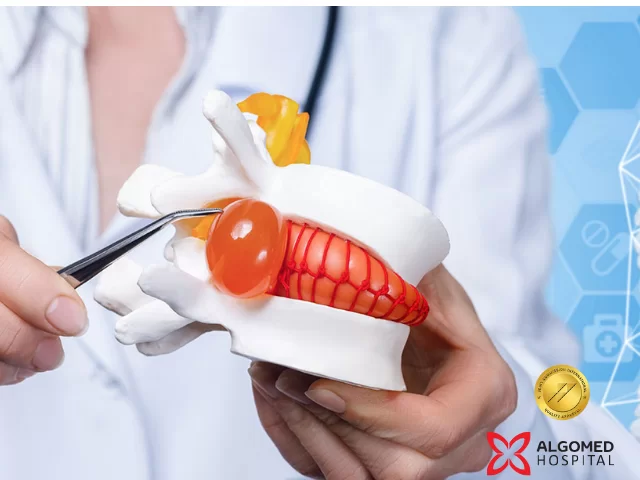
Every day our discs are subject to injury and degeneration when we use our backs. They compress and twist when you sit, bend over or lift a weight.
Repeated injuries weaken and eventually cause an annular tear.
With increasing pressure inside the discs, these tears produce a disc protrusion resembling an old, deformed tire.
If all the fibrous layers tear, the gelatinous core protrudes to the outside, causing a herniated disc. A protruded or herniated disc can put pressure on spinal nerves causing sciatica or radiculopathy.
Disc herniation can be present in both the cervical and lumbar regions.
If the hernia is found in the cervical area, people will have neck pain as well as symptoms in one arm such as loss of strength, numbness or loss of sensation.
If the hernia is found in the lumbar region, people will have lower back pain as well as symptoms in one leg such as loss of strength, numbness or loss of sensation.